
Chimpanzee (¶ÂµVµV)

orangutan (¬õ¤òµVµV)

Gorilla (ª÷èµVµV)
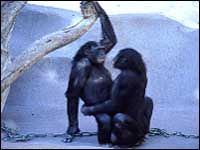
bonobo (¤Ú¿Õ¥¬·á/¨Ü¾§¶ÂµVµV)
You should be able to answer these questions:On Gallup's article
On Povinelli's article
- What's wrong with the argument in the first paragraph?
- What is the mirror test? What count as passing / failure? Which species consistently pass the mirror test?
- The rhesus monkeys can know from watching the mirror that Gallup entered the room. Does this show that they mirrors display reflections?
- Why are pairs of mirrors used in the case of Gorillas? What hypothesis is this setup supposed to rule out?
- From the information in the article, which part of the brain might be involved in self-recognition?
- Consider the experiment with live and delayed video. Is there a way to explain the results without saying that 2 and 3 year olds do not have a concept of the self?
- Someone has suggested that although chimps can pass the mirror-test, they do not think "that's me with the spot" when they see the mirror. Rather, they think something like "that animal has a spot, maybe I have one too.". If this explanation is correct, does it show that chimps can pass the test without a concept of the self?
- Which example about a chimpanzee is used by Gallup to criticize Povinelli?
- If you have to sum up the main theme of Povinelli's article in one single sentence, what would you say?
... Gallup's (1970) suggestion that self-recognition might be limited to the great apes (¤j·á) has held up well. Numerous studies have confirmed self-recognition in chimpanzees and there is now information regarding the importance of early social experience (Gallup et al. 1971), along with data on developmental trends and individual differences (Lin et al. 1992; Povinelli et al. 1993). What about other species of great apes? Self-recognition in orangutans is well established (Suarez and Gallup 1981), and several individuals in two captive groups of bonobos have shown mirror-mediated self-exploration (Hyatt and Hopkins 1994; Walraven et al. 1995) indicative of self-recognition. On the other hand, most studies have failed to find convincing evidence in gorillas, in spite of modifications to the original mirror and mark test procedure (Suarez and Gallup 1981; Shillito et al. 1999). There is one claim of positive evidence for a gorilla (Patterson and Cohn 1994) which has had extensive contact with humans from an early age. It has been hypothesized that under normal circumstances the capacity for self-recognition may not develop in gorillas, but that enculturation in the form of early and extensive rearing by humans may result in the formation of critical neural connections required for the expression of this capacity.
|
Chimpanzee (¶ÂµVµV) |
orangutan (¬õ¤òµVµV) |
|
Gorilla (ª÷èµVµV) |
bonobo (¤Ú¿Õ¥¬·á/¨Ü¾§¶ÂµVµV) |